
English


T: +86-572-6200777
Mr. Xin: +86-17357227212
Mr. Xin: +86-17357227212
Mr.Li: +86-13706256441
Building 31, Tianneng Chain Innovation Industrial Park, Meishan Town, Changxing County, Huzhou City, Zhejiang Province

Views: 0 Author: Site Editor Publish Time: 2026-11-07 Origin: Site


The operational integrity of any cleanroom environment relies entirely on the performance of its advanced air filtration systems. Whether you are managing pharmaceutical compounding, sterile medical device packaging, or advanced semiconductor manufacturing, the stakes are incredibly high. At the very heart of this critical infrastructure lies the HEPA filter paper. This foundational material acts as the ultimate barrier. It captures microscopic airborne contaminants that could otherwise compromise sensitive manufacturing processes or endanger patient safety.
However, selecting the appropriate particulate barrier is rarely as simple as choosing the product with the highest available efficiency rating. Cleanroom engineers, facility operators, and procurement managers consistently face a complex aerodynamic challenge. We must balance ultra-high filtration efficiency with the inevitable, energy-consuming air resistance it creates.
This comprehensive guide aims to demystify the technical differences between H13 and H14 filter grades. We will break down the underlying physics of pressure drop and provide a clear, actionable framework for selecting the optimal filtration substrate for your specific cleanroom applications.
Key Takeaways
The Core Component: The physical and chemical quality of the filter media directly dictates the overall performance, operational lifespan, and energy consumption of cleanroom HVAC systems and Fan Filter Units.
H13 vs. H14: Governed by the strict EN 1822 standard, H13 media provides a 99.95% efficiency rate at the Most Penetrating Particle Size. In contrast, H14 delivers 99.995% efficiency, making it the mandatory baseline for stringent ISO-class environments.
Pressure Drop is Critical: Achieving higher filtration efficiency naturally results in increased air resistance. Selecting highly optimized, low-resistance media is absolutely vital for minimizing long-term energy costs and preventing premature fan motor failure.
Material Matters: Premium H14 glass fiber filter paper remains the undisputed industry gold standard. It consistently achieves the delicate engineering balance between ultra-high particulate efficiency and sustainable aerodynamics.
To truly grasp cleanroom filtration, one must first examine its foundational component. HEPA filter paper, or High-Efficiency Particulate Air filter media, is a highly specialized, non-woven material. It is typically manufactured from a dense matrix of sub-micron borosilicate glass fibers. Unlike standard commercial HVAC filters that act much like a simple physical sieve, this advanced media is engineered through a sophisticated wet-laid process. This creates a randomized, tortuous path of microscopic fibers designed to capture airborne contaminants through complex fluid dynamics.
Specifically, the filtration process relies on three distinct physical mechanisms to trap particles effectively as they navigate the fiber matrix.
Interception: Mid-sized particles follow the airstream as it flows around the filter fibers. Because the particles are large enough, they brush against the fiber surface and become permanently attached.
Impaction: Larger, heavier particles possess too much inertia to adapt to sudden changes in airflow direction. They travel in a straight line, crashing directly into the fibers where they become embedded.
Diffusion: For the smallest particles, typically below 0.1 microns, Brownian motion takes over. These tiny particles collide with gas molecules, causing them to move in an erratic, zigzag pattern. This chaotic movement exponentially increases the probability that they will strike a fiber and be captured.
In practice, standard commercial air filters are entirely insufficient for controlled environments because they allow micro-contaminants to bypass the media. In cleanrooms governed by ISO 14644-1 standards, specialized HEPA media is non-negotiable. Think of a microelectronics fabrication plant where a single microscopic dust particle can short-circuit a silicon wafer, or an oncology compounding lab requiring absolute sterility. Premium filter media ensures the environment remains uncontaminated, safe, and fully compliant with international regulatory demands.
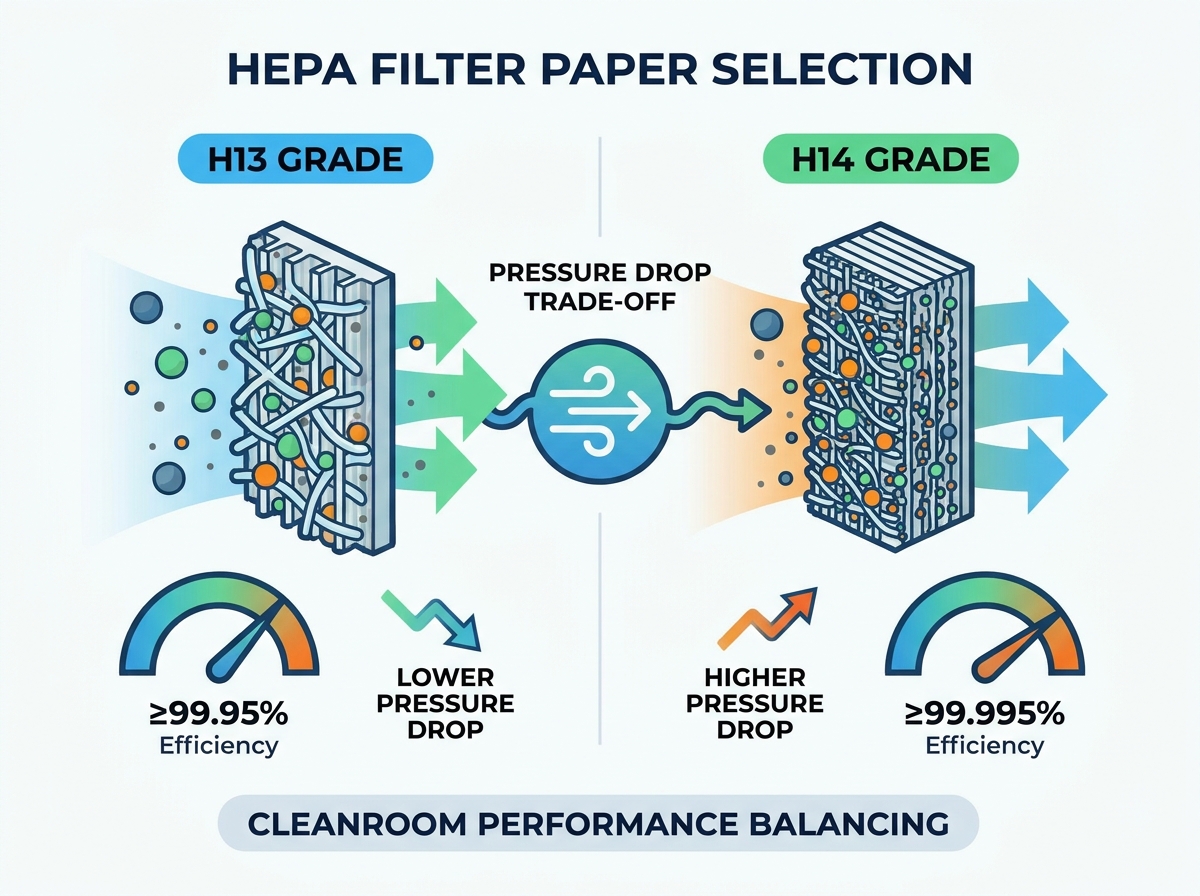
When evaluating filtration substrates, procurement teams will immediately encounter the global benchmark for performance classification. This is the European standard EN 1822. This rigorous testing protocol evaluates filter media based on its performance against the Most Penetrating Particle Size. This metric represents the specific particle size that is the most difficult to capture, usually falling between 0.1 and 0.3 microns. Filters are subsequently classified based on their minimum efficiency at this exact, most challenging size.
Under the EN 1822 classification, H13 media must demonstrate a minimum filtration efficiency of 99.95% at the Most Penetrating Particle Size. This means that out of 10,000 particles of the most difficult size, only 5 are allowed to pass through the barrier. H13 is highly versatile and serves as the backbone for many industrial applications. It is typically specified for ISO 7 and ISO 8 cleanrooms. Common use cases include secondary gowning rooms, commercial-grade air purifiers, hospital waiting areas, and less stringent medical device manufacturing zones.
In contrast, H14 represents a significant leap in particulate control. To achieve an H14 rating, the media must capture at least 99.995% of particles at the most challenging size. Mathematically, it allows only 5 out of 100,000 particles to penetrate. This makes it exactly ten times more efficient at stopping the most penetrating particles than H13. Because of this extreme efficiency, H14 media is the strict requirement for ISO 5 and ISO 6 cleanrooms. It is the absolute standard for critical environments such as surgical operating theaters, highly sterile pharmaceutical filling lines, and advanced nanotechnology labs.
To make the selection process clearer, here is a breakdown of the core differences between the two grades:
Filter Grade | Efficiency at MPPS | Target ISO Class | Typical Applications |
|---|---|---|---|
H13 | ≥ 99.95% | ISO 7, ISO 8 | Gowning rooms, medical device prep, commercial purifiers |
H14 | ≥ 99.995% | ISO 5, ISO 6 | Semiconductor fabs, sterile compounding, operating theaters |
Choosing between H13 and H14 requires aligning the filter grade directly with your facility's regulatory requirements. Over-specifying, such as using H14 when H13 is legally sufficient, can lead to unnecessary energy costs. Conversely, under-specifying will inevitably result in failed cleanroom certifications and contaminated products.
Filtration efficiency is only one half of the cleanroom engineering equation. The other, equally critical factor is pressure drop. In aerodynamics and HVAC design, pressure drop, measured in Pascals, refers to the loss of static air pressure as airflow is forced through the dense, restrictive fiber matrix of the filter.
When evaluating media on the front lines, engineers must monitor two distinct metrics. Initial pressure drop is the baseline air resistance of a brand-new, completely clean filter operating at its nominal airflow velocity. Final pressure drop, also known as terminal pressure drop, is the maximum acceptable resistance before the filter must be replaced. As the paper captures dust and particulate matter over its lifespan, the microscopic pathways for air become increasingly blocked. This causes the resistance to rise steadily.
Ignoring pressure drop specifications can have catastrophic financial and operational consequences for a facility. I routinely see large-scale semiconductor fabs running thousands of Fan Filter Units around the clock. In these environments, a mere 50 Pascal increase in baseline resistance can translate to tens of thousands of dollars in wasted electricity annually. Furthermore, forcing air through overly restrictive media places immense mechanical and thermal stress on fan motors. This leads to overheating, premature bearing failure, and costly operational downtime.
Cleanroom engineers constantly face a fundamental physics dilemma. There is an inverse relationship between filtration efficiency and airflow. Upgrading a system from H13 to H14 naturally increases the density of the fiber matrix. Without optimization, this denser material will drastically increase the pressure drop, crippling the system's airflow and skyrocketing energy costs.
From an industry trend perspective, the global push for sustainable manufacturing and energy-efficient HVAC systems is fundamentally reshaping how facilities approach air purification. Recent market analyses indicate a massive pivot away from traditional, highly restrictive media. Instead, modern cleanrooms are prioritizing lifecycle cost analysis and Environmental, Social, and Governance compliance. Facilities are no longer just looking at the initial purchase price. They are actively adopting H14 glass fiber filter paper that explicitly features aerodynamic optimizations. This shift underscores a broader realization: reducing the electrical load of Fan Filter Units is now just as critical as maintaining absolute particulate control.
The modern engineering solution lies in advanced manufacturing. By manipulating the fiber diameter distribution, binder resins, and pleating geometry, top-tier manufacturers have developed specialized low-resistance solutions. For example, high-performance H14 glass fiber media is now engineered to deliver a basis weight of 70 to 75 grams per square meter while keeping the initial pressure drop around 110 to 120 Pascals at standard testing velocities. This allows facilities to achieve stringent ISO 5 efficiency without the traditional penalty of high air resistance. It ensures that HVAC blowers can maintain the necessary Cubic Feet per Minute capacity while operating at lower, energy-saving motor speeds.
The raw material composition of the filtration substrate dictates its performance, durability, and chemical stability. While there are several options on the market, two materials dominate the cleanroom sector.
Borosilicate micro-glass fiber is the undisputed industry standard for heavy-duty cleanroom filtration. The manufacturing process involves blending various diameters of glass fibers to create a resilient web that offers maximum dust-holding capacity and structural integrity. Glass fiber offers exceptional temperature resistance, making it safe for high-heat environments. It also boasts absolute chemical stability, meaning it does not degrade when exposed to standard cleanroom sanitization agents. Consequently, advanced manufacturing techniques have made it possible to produce low-resistance HEPA filter media that perfectly balances the stringent H14 efficiency requirements with exceptional aerodynamics.
Conversely, Polytetrafluoroethylene, commonly known as PTFE, is an alternative membrane technology known for its ultra-low pressure drop and high durability against mechanical damage. However, PTFE comes with notable drawbacks. It is significantly more expensive than glass fiber, making it cost-prohibitive for large-scale facilities. Additionally, depending on the specific stretching process, some synthetic media can be prone to chemical off-gassing. This is strictly prohibited in environments sensitive to airborne molecular contamination. For the vast majority of pharmaceutical, medical, and industrial cleanrooms, glass fiber remains the most reliable and cost-effective choice.
For procurement managers and facility engineers, selecting the correct filter media is a high-stakes decision. Following a structured, objective evaluation process ensures compliance and operational efficiency.
Determine Your ISO Class Requirement: Begin by identifying the exact ISO 14644-1 classification required for your facility. Match the cleanroom class directly to the filter grade. Use H13 for ISO 7 and ISO 8 environments, and mandate H14 media for ISO 5 and ISO 6 critical zones.
Calculate Required Airflow and Velocity: Analyze the required air exchange rates and total volume of your HVAC system. Ensure that the chosen media possesses the tensile strength to handle the required air velocity without tearing, shedding fibers, or developing micro-leaks.
Evaluate the Pressure Drop Specs: Never purchase media based on efficiency alone. Demand verified technical data sheets detailing the initial pressure drop at your specific operating velocity. Integrating a premium low-resistance H14 glass fiber filter paper will translate directly to long-term operational savings.
Assess Dust Holding Capacity: Dust Holding Capacity measures the mass of particulate matter the filter can trap before reaching its terminal pressure drop. Media with a higher capacity requires less frequent replacement. This extends the maintenance cycle and dramatically reduces facility downtime.
Request Testing and Certifications: Objective validation is mandatory. Require the supplier to provide individual scan test reports compliant with the EN 1822 standard. This proves the specific batch meets the advertised efficiency and is free of pinhole leaks.
Even experienced procurement teams can make costly errors when sourcing cleanroom filter media. Avoiding these common pitfalls is essential for maintaining facility integrity.
Ignoring the Operating Costs: Focusing solely on the upfront purchase price is a critical financial error. Buying cheap media with a high initial pressure drop will force HVAC fans to consume excessive power. Over a three to five-year lifespan, the hidden electricity costs will easily dwarf the initial savings.
Using H14 When H13 is Sufficient: While H14 offers superior filtration, it inherently presents higher air resistance than H13. Over-specifying the filter grade for an ISO 8 room unnecessarily increases capital expenditure and restricts system airflow without providing any tangible regulatory benefit.
Overlooking Media Pleatability: Filters are constructed by deeply pleating the paper to maximize surface area. If the raw material lacks the necessary tensile strength or flexibility, it will crack or fracture at the pleat tips during manufacturing. This leads to immediate failure during leak testing.
Selecting the appropriate particulate barrier for a cleanroom environment is a highly technical, delicate balancing act. Facility engineers must ensure they achieve the absolute purity required by their specific industry. This means carefully choosing between H13 and H14 grades while simultaneously maintaining operational efficiency by strictly managing air resistance.
Investing upfront in engineered low-resistance glass fiber filter media is a financially sound strategy. High-quality media pays for itself multiple times over through substantial energy savings, reduced strain on HVAC infrastructure, and extended replacement cycles.
Before finalizing your next cleanroom construction or maintenance cycle, it is highly recommended to consult directly with a specialized filter media manufacturer. By doing so, you can source engineered, high-quality solutions tailored specifically to your facility's aerodynamic and regulatory demands. Evaluate your system's fan capacity, calculate your lifecycle costs, and choose a substrate that protects both your product and your bottom line.
Yes, but you must carefully evaluate your HVAC system's fan capacity first. Because H14 generally presents a higher pressure drop than H13, your blower motors must be powerful enough to push air through the denser media. If they are not, upgrading will drastically reduce your air exchange rate. Sourcing highly optimized, low-resistance H14 media can effectively mitigate this issue.
While exact numbers vary based on the manufacturer, pleat depth, and testing air velocity, a high-quality, low-resistance H14 media typically exhibits an initial pressure drop between 110 Pa and 160 Pa at standard testing velocities. Always consult the manufacturer's technical specification sheet for precise aerodynamic data.
In a properly engineered cleanroom equipped with adequate pre-filtration, such as G4 and F8 units designed to catch larger ambient dust particles, the terminal filter can last anywhere from three to five years. In highly controlled environments with minimal external contamination, they can occasionally last up to seven years before the final pressure drop dictates a mandatory replacement.
Yes, glass fiber is the most widely used, rigorously tested, and trusted material in cleanroom filtration due to its exceptional thermal and chemical stability. However, for highly specialized microelectronics cleanrooms that are extremely sensitive to airborne molecular contamination, specifically regarding boron off-gassing, specialized low-boron glass fiber or PTFE media might be explicitly specified by the facility engineers.
While HEPA media targets particles at 0.3 microns with up to 99.995% efficiency, ULPA filter paper is designed for even stricter environments. ULPA filters capture 99.999% of particles down to 0.12 microns. ULPA media is significantly denser, which results in a much higher pressure drop, making it suitable only for ISO 3 and ISO 4 cleanrooms where extreme nanotechnology or semiconductor manufacturing occurs.
High humidity can negatively impact standard filter media by causing the fibers to swell or degrading the binder resins. This can increase pressure drop and reduce the structural integrity of the pleats. Premium glass fiber HEPA media is naturally moisture-resistant, but cleanrooms should still strictly regulate internal humidity levels to prevent condensation and potential microbial growth on the filter face.


