
English


T: +86-572-6200777
Mr. Xin: +86-17357227212
Mr. Xin: +86-17357227212
Mr.Li: +86-13706256441
Building 31, Tianneng Chain Innovation Industrial Park, Meishan Town, Changxing County, Huzhou City, Zhejiang Province

Views: 0 Author: Site Editor Publish Time: 2026-10-01 Origin: Site


While filter paper is ubiquitous in basic laboratory procedures, specifying it for industrial-scale filtration requires precise alignment of retention rates, flow dynamics, and material compliance. You cannot simply grab any off-the-shelf cellulose sheet and expect optimal performance on a production line. Industrial-grade filter paper functions as a specialized semi-permeable barrier. We engineer it specifically for precise solid-liquid or solid-gas separation under demanding conditions. It balances high throughput requirements against strict particulate retention targets.
This article serves as a technical guide for engineers, lab managers, and procurement teams. You will learn how to evaluate, shortlist, and implement the correct filter media. We cover how to match these materials directly to your specific operational requirements and regulatory demands, ensuring efficient and reliable separation.
Industrial separation processes often face a common bottleneck. Facilities must achieve high-purity solid-liquid separation without inflating consumable costs. They also cannot afford to slow down production cycles. This creates a challenging business problem. Engineers constantly evaluate different media to resolve these issues. You must choose a material offering consistent performance under pressure.
Many facilities compare paper media against alternative solutions. You might consider membrane filters, sintered metal, or industrial centrifuges. Each alternative has unique strengths. However, Filter Paper stands out for its extreme cost-effectiveness. It offers unmatched ease of disposal after use. You can simply discard the spent media, reducing cross-contamination risks. Single-use scenarios benefit heavily from this trait. Heavy metal filters require rigorous cleaning cycles. Centrifuges demand massive capital investment and maintenance. Paper media bypasses these hurdles entirely.
Successful implementation relies on defining strict criteria. What does a successful filtration cycle look like? First, you need zero media migration into the final filtrate. Second, the system must deliver predictable flow rates. Operators rely on this consistency for batch scheduling. Finally, you must ensure compliance with relevant standards. FDA or USP certifications are non-negotiable in many sectors. We see the best results when engineers align these criteria early in the design phase.
Different industries utilize paper filters for highly specialized tasks. We see diverse applications spanning from micro-labs to massive manufacturing plants. Each sector demands unique material properties and strict compliance adherence.
Pharmaceutical manufacturing requires absolute purity. Facilities use specialized paper to clarify active pharmaceutical ingredients (APIs). The media removes unwanted precipitates during synthesis. Chemical processing relies heavily on these filtration steps as well. You must select low-extractable media for these tasks. Extractables can leach into the batch and ruin the product. Strict regulatory requirements dictate these choices. Preventing contamination remains the highest priority for any chemical engineer.
Food producers process massive volumes of liquids daily. They use paper filters for syrup clarification and edible oil filtration. Brewing facilities rely on them for strict quality control. Removing yeast and haze ensures a clear final beverage. These processes require media possessing food-grade certifications. High wet-strength capabilities are also mandatory here. The paper must withstand heavy fluid pressure without tearing. A ruptured filter ruins the entire batch and forces costly reprocessing.
Field technicians use filtration for critical environmental assessments. Soil testing and water quality analysis depend on accurate separation. You must filter out suspended solids to test groundwater. The petrochemical industry also tests drilling fluids regularly. These sectors focus heavily on standard compliance. EPA methodologies dictate exact pore sizes and media types. Data integrity relies entirely on using the specified materials.
Manufacturing plants generate substantial amounts of metal debris. They use industrial paper filters to recover cutting fluids. Removing particulates extends the lifespan of expensive machinery. Clean coolant prevents excessive tool wear and maintains proper thermal regulation. We see major cost savings when plants implement proper fluid recycling. The paper captures fine metal shavings efficiently, allowing the facility to reuse the expensive coolant liquids.
Understanding the fundamental divide in filter types is crucial. Manufacturers produce media in two primary categories. You must select the right classification to ensure accurate results and maintain process safety.
Qualitative media serves general laboratory and industrial purposes. We use it for standard clarification and precipitate recovery. It works perfectly for qualitative analysis where you do not burn the filter. You evaluate this material through specific lenses. Assess it based on standard flow rate categories. Vendors classify these as fast, medium, or slow. You also need to verify general material compatibility. It must withstand the specific solvent without dissolving or shedding fibers.
Quantitative media handles highly critical analytical preparations. Facilities use it for gravimetric analysis. In these procedures, technicians ignite and burn the paper away completely. The evaluation lens changes significantly here. You must focus on strict ash content tolerances. High-quality ashless paper leaves less than 0.01% residue. It also features high wet-strength variations for pressure filtration setups.
Filtration Media Classification Matrix
| Feature | Qualitative Media | Quantitative Media |
|---|---|---|
| Primary Purpose | General clarification, standard separation | Gravimetric analysis, critical analytical prep |
| Ash Content | Standard (Leaves residue when burned) | <0.01% (Ashless upon ignition) |
| Flow Rate Focus | Broad categories (Fast, Medium, Slow) | Highly specific retention ratings |
| Best Used For | Liquid recovery, bulk debris removal | Precision weighing, environmental testing |
To maintain data integrity, you need a clear decision matrix. Use qualitative media for general fluid clarification and sample prep. Upgrade to quantitative media when your process requires gravimetric weighing. If you must burn the sample to measure particulate mass, ashless paper becomes strictly mandatory.
Procurement goes beyond picking a random micron rating. You must evaluate specific physical and chemical parameters. This ensures the media performs reliably under your specific operational conditions.
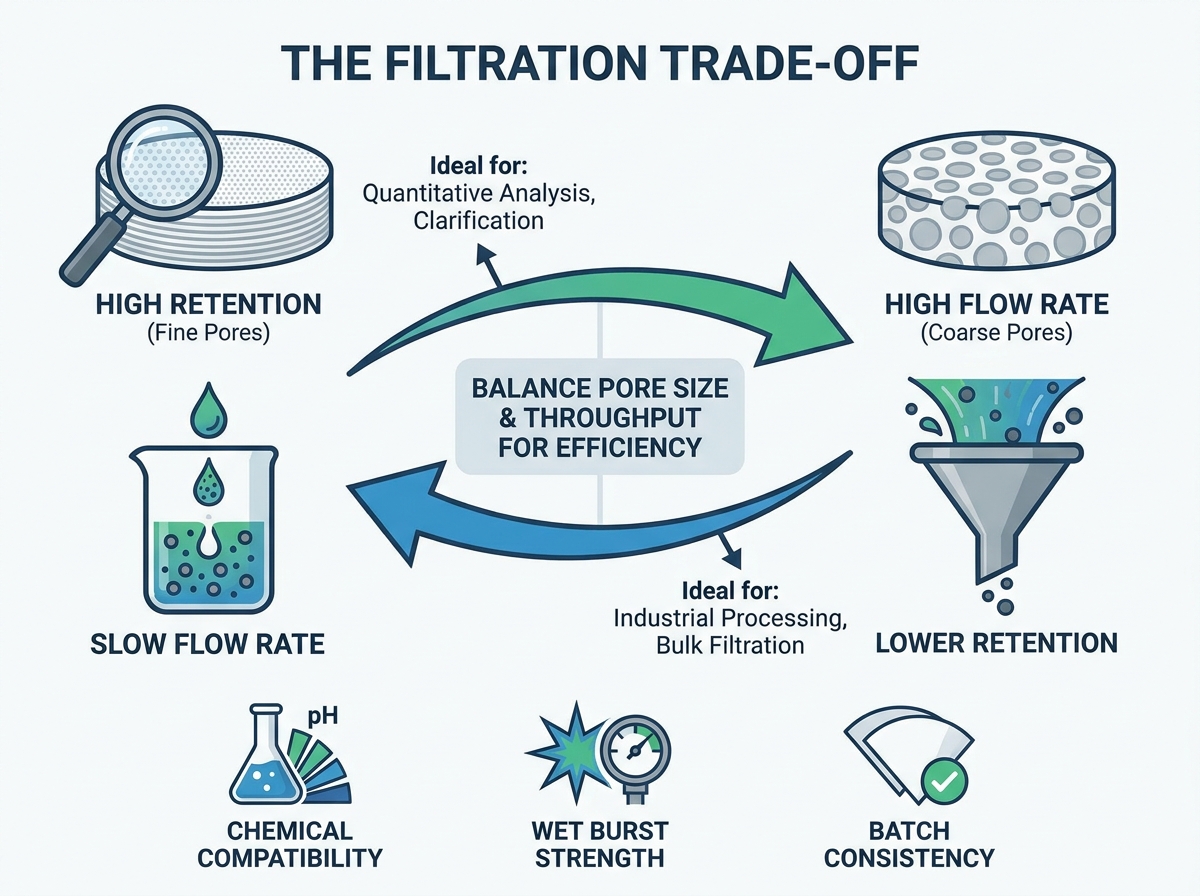
Engineers constantly balance particle retention against processing speed. Micron rating and volumetric throughput share an inverse relationship. Smaller pore sizes capture finer particles effectively. However, they drastically reduce your overall flow rate. You must identify your minimum viable retention limit. Do not choose a 1-micron filter if a 10-micron filter suffices. Maximizing your pore size maximizes your processing speed. This simple adjustment prevents severe production bottlenecks and optimizes consumable usage.
Standard cellulose media has distinct chemical limitations. Highly acidic or basic solvents will degrade standard paper quickly. The material breaks down and contaminates the filtrate. You must outline the exact pH of your process fluid. Introduce glass microfiber media for aggressive chemicals. Specialized synthetic blends also serve as excellent alternatives. They resist harsh solvents and maintain structural integrity during extended exposure.
Industrial apparatuses subject filters to intense physical stress. You must evaluate the mechanical demands of your equipment. Buchner funnels and vacuum pumps create high-pressure differentials. Industrial filter presses squeeze media with immense force. You need to read and understand wet burst strength metrics. This prevents the paper from tearing during continuous processing. A tear compromises the entire filtration cycle. We strongly advise discussing these metrics with a provider's services team to pinpoint the exact structural strength required.
Scaling up introduces new variables and distinct risks. You must anticipate these challenges to maintain smooth operations and avoid costly downtime.
Premature clogging represents a massive operational risk. High-particulate or gelatinous fluids blind the filter surface quickly. The pores seal up, and flow stops completely. You must deploy mitigation strategies to prevent this. Using dedicated pre-filters removes larger debris first. Fluted paper configurations also increase the available surface area. This extends the media's lifespan significantly and maintains steady throughput.
Sourcing unbranded or low-tier media introduces severe variability. You risk experiencing inconsistent flow rates across different batches. This compromises your overall quality control. Reliable manufacturing demands predictable consumable performance. We advise securing strict consistency guarantees from your vendor. Reading about us pages on supplier websites often reveals their commitment to rigorous manufacturing standards.
Translating a benchtop test to a production line is difficult. Small-scale trials often fail to replicate industrial pressures accurately. A paper that works in a small funnel might tear in a massive mechanical press. You must account for increased fluid dynamics and prolonged exposure times. Engineers should run pilot-scale tests before committing to full facility deployment.
Follow a strict sequential action plan for procurement. This minimizes risk and ensures optimal performance on the floor.
If you encounter challenges mapping these steps to your process, you can always contact us directly for technical guidance.
A: Filter paper generally utilizes depth filtration. It traps particles within a complex matrix of cellulose fibers. Membrane filters provide absolute surface retention, utilizing precise microscopic pores to block particles on the surface. Membranes handle ultra-fine filtration, while paper excels at high-capacity particulate loading and clarification.
A: No. Industrial cellulose media functions strictly as a single-use consumable. Reusing it risks severe cross-contamination and structural failure. This single-use nature contrasts sharply with washable metal filters, making paper ideal for highly regulated batches requiring fresh media every time.
A: Match the pore size to your target particulate diameter. Identify the smallest particle you need to remove. Select a micron rating just below that diameter. Avoid choosing an excessively fine rating, as it will unnecessarily restrict your flow rate and cause premature clogging.
A: Yes. It degrades over time due to ambient humidity and temperature fluctuations. Moisture absorption weakens the cellulose fibers and alters flow rates. Additionally, prolonged exposure can degrade the purity of ashless properties. Always store your media in dry, climate-controlled environments and observe manufacturer shelf-life guidelines.


