
English


T: +86-572-6200777
Mr. Xin: +86-17357227212
Mr. Xin: +86-17357227212
Mr.Li: +86-13706256441
Building 31, Tianneng Chain Innovation Industrial Park, Meishan Town, Changxing County, Huzhou City, Zhejiang Province

Views: 0 Author: Site Editor Publish Time: 2026-10-28 Origin: Site


Precise filtration prevents critical industrial failures. A single microscopic particle can ruin an entire production batch or compromise a sterile environment. Managing air and liquid purity serves as the backbone of operational success in modern industrial, medical, and laboratory settings.
At the heart of these high-performance systems lies glass fiber filter paper. Engineers widely consider it the gold standard material for capturing sub-micron contaminants. However, choosing the right media often feels daunting. Procurement managers and facility engineers frequently struggle to balance technical specifications like aerodynamic resistance and particle retention.
This guide walks you through the nuances of evaluating filtration efficiency and managing pressure drop limits. Understanding its core properties will equip you to select the perfect filtration media for your specific operational needs.
Optimal Balance: Selecting the appropriate media requires a careful compromise between high filtration efficiency and a manageable pressure drop. This maintains optimal energy consumption across the system lifecycle.
Grade Matters: Industrial applications demand highly specific specifications ranging from medium flow rate laboratory materials to ultra-high-retention products designed for critical cleanrooms.
Environmental Resistance: This non-woven material excels in extreme environments. It delivers superior temperature stability and chemical resistance compared to standard cellulose alternatives.
Application Versatility: The media serves essential functions across heavy commercial HVAC systems, semiconductor manufacturing, and pharmaceutical laboratories.
Recent market shifts highlight a massive transition toward energy-efficient filtration media across heavy industrial sectors. As global electricity costs surge, facility operators no longer focus solely on particle retention. They actively prioritize low-resistance materials to drastically cut HVAC power consumption without compromising cleanroom integrity. Furthermore, stricter regulatory frameworks in semiconductor and pharmaceutical manufacturing push the demand for ultra-low penetration air media. Facilities are upgrading legacy systems to meet ISO Class 3 standards, making advanced micro-glass web technologies more critical than ever for maintaining compliance and reducing costly production downtime.
Unlike traditional cellulose-based sheets, this highly specialized non-woven web consists primarily of borosilicate micro-glass fibers. The physical characteristics of these fibers create an incredibly dense yet porous internal matrix. Fiber diameters typically measure between 0.1 and 10 micrometers. Imagine a microscopic, randomized three-dimensional net. This complex structural geometry allows the material to achieve an exceptionally high void volume often exceeding 90 percent. Because the core composition is entirely inorganic, it does not swell when exposed to ambient moisture. The pore structure remains rigidly stable under fluctuating environmental conditions.
The performance of this filtration media heavily depends on its manufacturing journey. Facilities typically produce it via a highly modified wet-laid process. Micro-glass fibers disperse into a liquid slurry under precise pH controls to prevent clumping. As the slurry deposits onto a moving wire mesh, water drains away to leave a uniform fiber web. Precise manufacturing parameters directly dictate the basis weight and thickness. This strict control ensures no thin spots exist that could compromise the structural integrity of the final filter element.
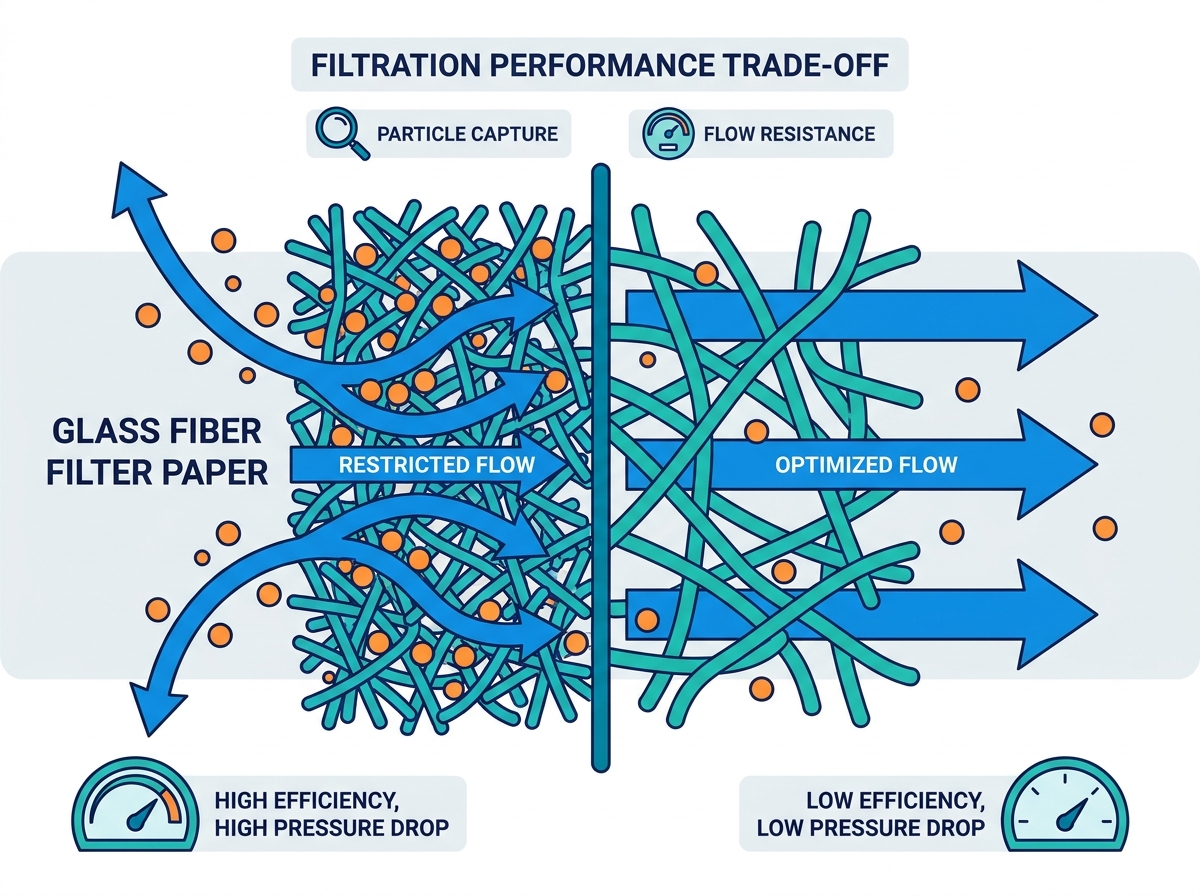
Before specifying a filter for a critical system, engineers must weigh the material capabilities against its physical constraints. Below is a direct comparison of how micro-glass performs against other common media options.
Feature | Glass Fiber Media | Cellulose Paper | Synthetic Media |
|---|---|---|---|
Particle Retention | Ultra-high down to 0.1μm | Medium | High |
Temperature Resistance | Up to 500°C | Up to 120°C | Up to 90°C |
Chemical Inertness | Excellent | Poor | Good |
Mechanical Strength | Low | Medium | High |
Moisture Resistance | Excellent | Poor | Excellent |
The primary draw of this material lies in its unparalleled particle retention rates combined with excellent fluid flow characteristics. The remarkably fine fibers easily capture sub-micron aerosols while offering lower fluid resistance compared to standard membrane filters of similar efficiency. Building on this structural advantage, the material exhibits remarkable thermal stability. Pure formulations withstand continuous operating temperatures up to 500 degrees Celsius, making them indispensable for hot exhaust gas filtration. Additionally, borosilicate glass is biologically inert. It prevents microbial growth and resists degradation from most industrial solvents and harsh chemicals.
Despite its superior capabilities, the material possesses inherent physical limitations. The most notable drawback is its fragility. Glass fibers have low tensile strength, leaving the paper highly susceptible to tearing, puncturing, or media migration if mishandled during installation. Consequently, industrial filter cartridges often require supportive synthetic scrims, delicate pleating techniques, or aluminum separators to prevent structural collapse under high air pressure. While broadly chemically resistant, the silica structure remains highly vulnerable to alkaline environments and dissolves rapidly upon contact with hydrofluoric acid.
Filtration within this specialized media is not a simple surface sieving process. It relies on a combination of intricate physical mechanisms that trap contaminants significantly smaller than the actual pore spaces. Larger, denser particles collide directly with the fibers through inertial impaction as the airstream violently curves around the matrix. Medium-sized particles graze the fiber surfaces and adhere via interception. For ultra-fine particulates below 0.3 microns, Brownian diffusion takes over. Their erratic, zigzagging movement dramatically increases the likelihood of striking a fiber and becoming permanently trapped.
In fluid dynamics, pressure drop measures the aerodynamic resistance that air encounters as it navigates the twisting path of the fiber matrix. Engineers constantly navigate a strict inverse relationship between retention capabilities and airflow resistance. Achieving higher efficiency necessitates a denser matrix with finer fibers, which inherently restricts flow and elevates the pressure drop.
For facilities requiring unparalleled purity, H14 grade filter media serves as the premier choice. Based on EN 1822 standards, a true H14 material delivers a minimum efficiency of 99.995 percent at capturing 0.3-micron particles. When selecting this premium grade, optimizing the initial resistance is crucial. A poorly specified filter will choke a system airflow, forcing fan motors to work exponentially harder. By investing in optimized media with a controlled basis weight and uniform fiber distribution, facilities achieve substantial lifecycle energy savings that far outweigh initial procurement costs.
Depending on the required mechanical strength, manufacturers formulate these papers with or without chemical additives. Binder-free variants consist of pure borosilicate glass. They represent the absolute standard for analytical and gravimetric testing where organic burn-off would skew precise laboratory results. Conversely, binder-added papers incorporate organic resins like acrylic during manufacturing. This crucial addition overcomes the natural brittleness of the glass. It provides the stiffness necessary for high-velocity industrial air filters that must endure rigorous machine pleating without fracturing.
In advanced microelectronics fabrication, a single microscopic speck of dust can short-circuit a silicon wafer and cause catastrophic financial losses. To maintain pristine conditions, semiconductor plants rely on ceiling-mounted Fan Filter Units equipped with HEPA glass fiber filter paper. This ensures a zero-particulate environment by capturing chemical aerosols and sub-micron dust with absolute, unfailing reliability.
Commercial data centers and high-density hospital wings run ventilation systems around the clock. These environments utilize deep-pleated pocket and rigid cell filters to maintain pristine indoor air quality. The exceptional dust-holding capacity of fiberglass media ensures that atmospheric pollutants remain trapped effectively over long maintenance cycles. This safeguards highly sensitive electronic equipment and human respiratory health.
Aseptic processing environments in the pharmaceutical industry operate under incredibly stringent regulatory frameworks. In biological safety cabinets and operating room ventilation systems, capturing viral carriers and bacterial spores remains a critical safety measure. The biological inertness of glass fibers ensures the filter itself does not become a breeding ground for pathogens. This maintains total sterility during critical drug compounding and invasive surgical procedures.
The foundational step in filter selection involves accurately identifying the specific contaminant profile of your environment. If your objective is protecting a sterile pharmaceutical packaging line, you must specify ultra-fine HEPA grades capable of intercepting 0.3-micron particles at 99.995 percent efficiency. Over-specifying unnecessarily chokes your airflow, while under-specifying leads directly to dangerous contamination bypass.
Filtration media must survive the unique stresses of its operational home. Carefully evaluate maximum operating temperatures and potential chemical exposures. If your industrial process involves hot exhaust gases exceeding 150 degrees Celsius, standard binder-added media will quickly degrade. This dictates a necessary shift to binder-free alternatives. Always verify chemical compatibility to prevent premature structural collapse in highly acidic or alkaline conditions.
Align the aerodynamic specifications of the filter paper with the mechanical capacity of your existing infrastructure. Calculate the required volumetric flow rate and determine the maximum differential pressure your facility blower motors can handle. Selecting a highly efficient paper that exceeds these limits results in system stalling, reduced air exchange rates, and skyrocketing energy costs. Review the manufacturer face velocity curves before finalizing a procurement decision.
Selecting the right filtration media requires a masterful balance between uncompromising particle retention and manageable aerodynamic resistance. Carefully evaluating your unique operating environment and system pressure limits allows you to implement a robust solution. This approach meets stringent industry regulations while drastically reducing long-term energy consumption.
Whether you are outfitting a semiconductor cleanroom, upgrading commercial HVAC systems, or maintaining pharmaceutical sterility, investing in high-quality materials acts as the ultimate safeguard against operational failure. Ready to upgrade your cleanroom filtration? Explore our high-performance H14 glass fiber filter paper at Meconm, specifically engineered for optimal efficiency, low pressure drop, and uncompromised structural integrity in critical environments.
The starkest contrast lies in their environmental resilience and structural stability. Traditional cellulose filter paper is highly cost-effective but prone to swelling, tearing, and rapid degradation when exposed to moisture or corrosive chemicals. Conversely, glass fiber media offers significantly higher fluid flow rates, exceptional chemical inertness, and much finer particle retention. It maintains dimensional stability in completely wet conditions and resists degradation, making it far superior for rigorous industrial applications.
No, manufacturers strictly engineer the vast majority of these filters for single-use applications. Attempting to wash, vacuum, or blow out the media irreversibly fractures the delicate micro-fiber matrix. Physical agitation creates microscopic tears that allow sub-micron contaminants to bypass the filter entirely. To maintain certified efficiency specifications, operators must safely discard and replace the media once it reaches its final resistance limit.
The H14 classification represents a highly regulated HEPA efficiency grade defined by the stringent European EN 1822 standard. It guarantees uncompromising performance by reliably capturing a minimum of 99.995 percent of airborne particles at the Most Penetrating Particle Size of 0.3 microns. This absolute level of filtration makes it a mandatory component for environments demanding zero-particulate air, such as infectious disease isolation wards and microelectronics fabrication plants.
The thermal endurance of the media depends entirely on its specific chemical formulation. Standard variants containing organic binders begin to outgas and structurally degrade at temperatures around 150 degrees Celsius. However, pure binder-free glass fiber paper remains exceptionally thermally stable. It withstands continuous exposure to extreme temperatures up to 500 degrees Celsius without melting, combusting, or compromising its filtration capabilities.
The lifespan heavily depends on the particulate load of the operating environment and the surface area of the filter design. In a typical commercial HVAC setting with proper pre-filtration, deep-pleated fiberglass filters can last anywhere from 6 to 12 months. In pristine cleanroom environments, HEPA ceiling panels might remain operational for 3 to 5 years before the pressure drop exceeds acceptable limits and requires replacement.
The ASHRAE MERV rating system and the European EN 1822 standard measure efficiency differently. However, an H14 grade filter roughly aligns with a MERV 20 rating. Both classifications represent the highest tier of commercial and industrial air purification, designed to capture microscopic viruses, carbon dust, and combustion smoke with near-perfect efficiency.


